- Risks and outages
Weather, vandalism, collisions, wildfires and even wildlife are among the main causes of tower collapses and line outages in Brazil. See how predictive intelligence can anticipate these risks and make power transmission more resilient.
Resilion2 min read
Resilion's vision is clear: help critical infrastructure companies prevent outages and reduce risk through a single platform for real-time visibility and predictive intelligence.
In power transmission, that means keeping the backbone of the country's energy sector standing. But to keep it from collapsing, we first need to understand the physical, climate and human forces that test these structures every day in Brazil.
The risk picture is highly dynamic
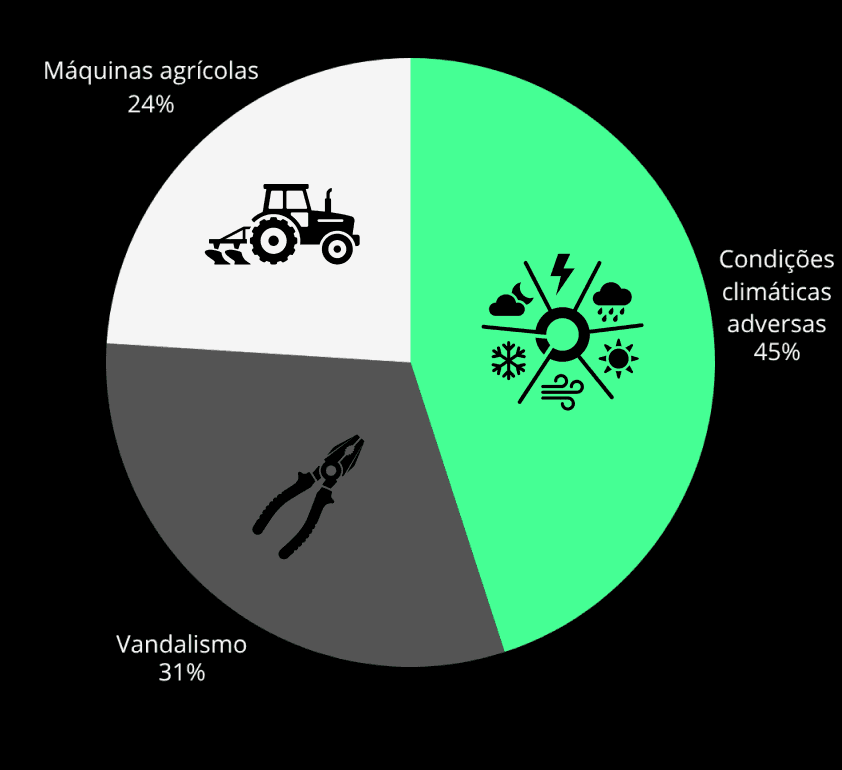
Transmission towers look permanent, but they face a far more dynamic set of risks than the eye can see. When one of them falls, the impact is immediate and severe. Beyond the direct risk of systemic blackouts, the financial loss for the operator can reach tens of millions of reais per event. Data from ONS (Brazil's national grid operator) for 2020 to 2024 shows a striking average of 21 tower collapses a year in the country, a number that hides a telling distribution of causes.
Then there are the human and geographic factors. About 31% of collapses come from vandalism, sabotage or theft, a persistent public safety problem, especially in the North and Northeast. In the Center-West and in São Paulo, on the other hand, today's oversized farm machinery strikes tower bases and guy wires during harvest maneuvers, accounting for 24% of collapses.
Beyond physical collapse, there are countless smaller events that don't bring a tower down but cause outages and cut into the operator's revenue. Adverse weather accounts for 47% of outages. The main culprit here is lightning: Brazil has the highest incidence of lightning strikes in the world. Strikes on the conductors or the towers produce voltage surges that exceed the line's insulation, creating short circuits that force an automatic shutdown. Strong winds swing the conductors and shrink the distance between them, or throw branches and debris against the line, which also causes short circuits. On top of that, wildfires, responsible for 28% of outages, ionize the air and cause severe arcing that interrupts the flow of power.
The Curicaca bird
Oddly enough, not every culprit is weather-related or human. Local wildlife plays a surprising role: the curicaca (buff-necked ibis) is responsible for 11% of outages in the country. Its droppings, which often contain conductive material, foul insulators and cause more interruptions than human error (7%) or vegetation problems (7%). It's a reminder that monitoring has to be sensitive to biological factors too, to prevent cascading failures.
With risks this varied, modern asset management can no longer be merely reactive. The path to resilience is to replace uncertainty with risk intelligence, bringing together IoT sensors, satellite imagery, weather forecasts and predictive intelligence. Turning raw data into operational visibility is the only way to anticipate the next windstorm or catch a wildfire before it reaches the line. At Resilion, we believe that knowing exactly what threatens the grid, and how well prepared it is for external shocks, is the first step toward keeping it always on.