- Extreme events
- Monitoring
- Technology
- Risk management
- Transmission
Sensors on transmission towers, combined with artificial intelligence and maintenance data, are changing how transmission lines are managed. Here is how the technology has evolved, and how Resilion turns isolated data into predictive intelligence that anticipates risks and protects assets.
Resilion5 min read
Brazil's power transmission infrastructure faces a growing number of extreme weather events, collisions with agricultural machinery and criminal activity. These threats cause an average of 21 tower collapses a year, with losses in the tens of millions of reais per event once repairs and fines are counted.
Today, operators have limited visibility into what is happening on their transmission lines. Substations have had some level of sensing for years, but transmission companies have few "eyes and ears" collecting information along thousands of kilometers of line.
To monitor risk at a finer level and manage it proactively, transmission companies are starting to install sensors on the lines themselves, either on the towers or on the conductor cables. This new monitoring model makes it possible to predict failures before they happen, with artificial intelligence (AI) driving the shift to prediction.
State of the Art in Sensing
Turning lines and towers into strategic sources of data depends on an ecosystem of sensing technologies that has evolved quickly in recent years.
Although large-scale adoption across Brazil's grid is still in its early stages, the market already offers proven solutions that cover everything from structural integrity to security threats.
The list below summarizes the main technology families and their direct impact on asset management.
- DLR (Dynamic Line Rating): a technology that recalculates a line's thermal capacity in real time from conductor temperature and ambient conditions, which can raise line capacity by 10% to 40%. Widely monetized in markets such as the United States and Europe, but Brazil's tariff rules don't yet reward it.
Executive Insight: The real gain in resilience comes not from adopting sensors in isolation but from being able to integrate them. Cross-referencing local weather data with structural vibration and with design and maintenance records shows the transmission company which assets are most exposed and vulnerable.
Evoltz's Part in This Story
Transmission towers are designed to withstand historical wind speeds, but recent collapses prove that extreme weather no longer follows the rulebook. Evoltz, the transmission company that founded Resilion, has had a number of tower collapses caused by winds above design limits, as well as collisions with agricultural machinery and sabotage.
To tackle these challenges, the company realized it needed to understand its risks better and to monitor them in real time with sensors. That set off an R&D effort that culminated in the launch of Resilion in 2025.
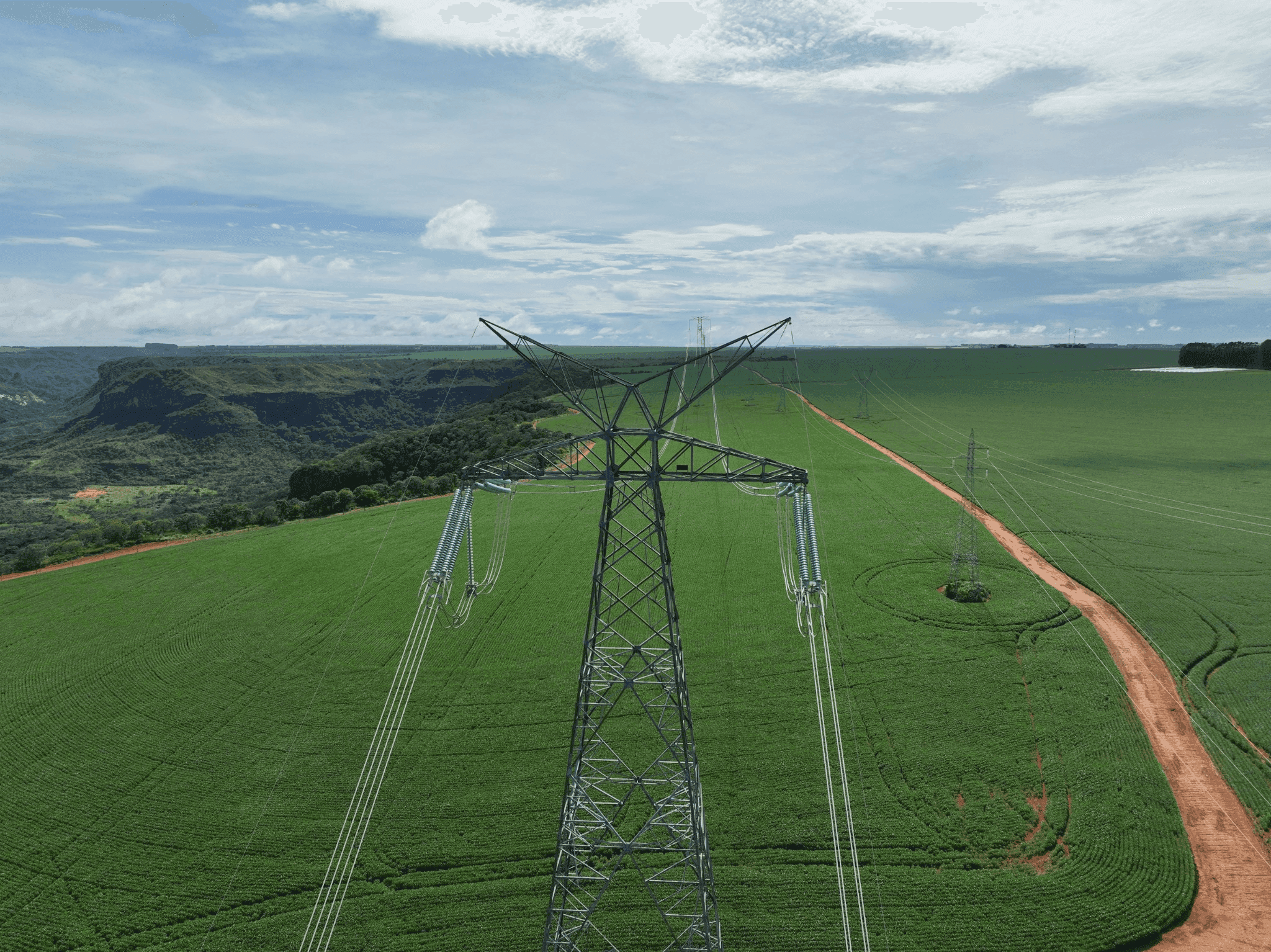
(Drone image of one of Evoltz's transmission towers)
Energy from the North to the Southeast
The main focus of this R&D cycle was the Norte Brasil Transmissora de Energia (NBTE) transmission line, a strategic 2,412 km direct-current asset with a total of 4,339 towers.
NBTE is the third-longest transmission line in the world! Imagine how hard it is to keep an asset like that running without interruptions, and to prevent tower collapses or outages.
The project set up experimental and monitoring infrastructure along the line, installing and operating 15 weather stations to collect environmental data. It also included SMART TRANSMISSION TOWER, a project under the R&D program of ANEEL, Brazil's electricity regulator, which received R$ 3.6 million in investment to build real-time monitoring prototypes. These prototypes carried experimental instrumentation made up of night-vision cameras and sensors for vibration, noise and angular displacement, using GSM and satellite links to send data back from the towers.
The initiative confirmed that vibration sensors and cameras can pick up the signatures of critical events such as extreme winds, vandalism and collisions. It also showed that sending data directly from the towers is technically feasible under real operating conditions.
From Lessons Learned to Resilion
Although the initial results were positive, the case study revealed critical barriers to large-scale rollout. A solution built on cameras and full weather stations was too expensive to deploy across thousands of towers.
On top of that, relying on GSM and satellite connectivity brought high operating costs and coverage gaps in remote regions. And without AI algorithms to interpret events automatically, the system was limited to spot monitoring, with no ability to deliver predictive alerts at scale.
Smarter Assets
The real leap in operational resilience comes when we stop monitoring isolated sensors and start managing the actual risk of each structure.
For all this data (weather, computer vision, acoustic and vibration) to make sense, you need an integrated platform that does more than aggregate the readings: it cross-references them directly with each asset's vulnerability and history.
That means the system understands the engineering behind each tower, knowing whether it is guyed or self-supporting, how tall it is and what wind limit it was designed for. Beyond that, the platform draws on the asset's maintenance data, correlating the last field inspection, the measured guy-wire tension and insulation resistance with real-time weather threats.
The practical result of this smart cross-referencing is simple, but it changes everything. Instead of just seeing a bare number on a dashboard, the operator understands, precisely and ahead of time, what that reading will actually mean for the integrity of the grid.
Everything on One Platform
This integrated view reaches its full potential with Resilion, which brings all of these layers of intelligence together on a single, centralized platform.
By unifying line sensing, weather monitoring and AI-powered diagnostics, Resilion eliminates the information silos that have historically fragmented asset management.
The result is an operating environment where raw data is processed and put in context automatically, so managers can see the health status of every tower in a simple, intuitive interface.
The technical complexity of the grid is turned into strategic clarity, so that every alert the platform issues actually supports the decisions that keep transmission infrastructure running safely and resiliently.
Is your operation ready to stop reacting to failures and start predicting them?
Follow our series of articles on resilience in the transmission sector, or contact our specialists to learn how predictive intelligence can shield your assets.