- Sensors and monitoring
Transmission operators who run their own weather networks get more accurate local data, which helps them monitor risks and make decisions when conditions turn critical.
Resilion3 min read
Today's post was written in partnership with Dr. Fernanda Tayt-Sohn, who holds a degree in meteorology and is the founder and chief consultant of Tempo Certo Meteorologia (https://tempocertometeorologia.com.br/). Thanks for your contribution, Fernanda!
Weather stations serve two main purposes. The first, and the more obvious, is continuous monitoring of atmospheric conditions. The second is supplying data to numerical weather prediction models, which use those observations to describe the initial state of the atmosphere more accurately. At conventional stations, observations are taken every three hours, eight a day, four of which are considered primary (00Z, 06Z, 12Z and 18Z). Each observation records parameters such as air temperature, relative humidity, atmospheric pressure, wind speed, precipitation, solar radiation and a range of other meteorological variables. Automatic stations, by contrast, measure continuously and transmit at regular intervals, which allows near-real-time monitoring.
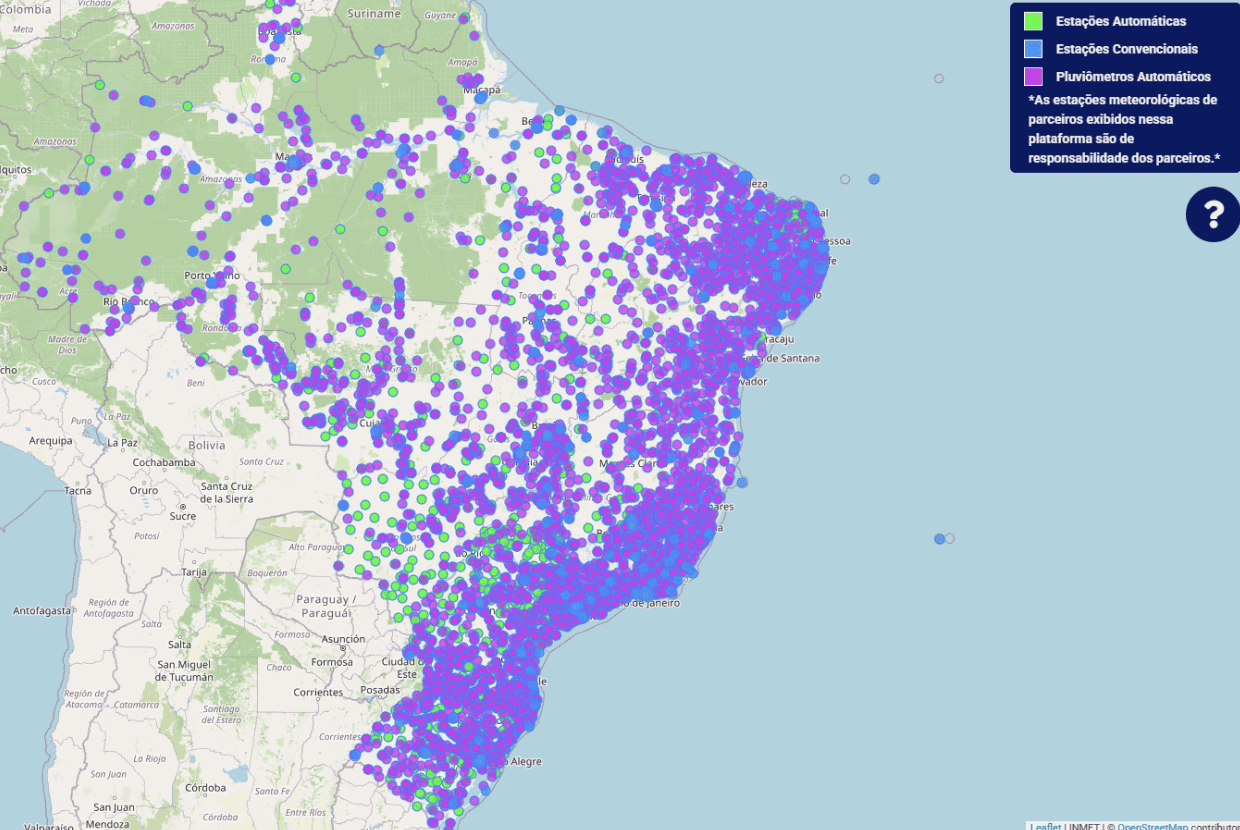
The United States, which is similar to Brazil in land area, has roughly 35,000 integrated weather observation points. Brazil has about 2,000 official weather stations, automatic and conventional combined, spread across the whole country.
The gap in station counts between Brazil and the United States is large, but it is not the most striking part. Within Brazil, station density varies widely from one region to another. The North, despite being the largest region by area, has a much sparser observation network, while the Southeast has a dense one. This uneven coverage directly affects the quality of weather monitoring and how well numerical forecast models can assimilate data.
Map of weather stations run by INMET, Brazil's national weather service, showing the difference in station density across Brazil's regions (source: https://mapas.inmet.gov.br/)
Given that picture, deploying your own weather network is an important operational advantage in sectors where weather plays a strategic role, such as transmission and distribution utilities, hydro, wind and solar generation companies, and water and sanitation companies, among others, especially in low-density regions. These networks increase the spatial and temporal resolution of observations and produce information that better represents local atmospheric conditions. As a result, they make meteorological analysis, numerical modeling and site-specific forecasts more precise, supporting risk management, operational planning and decision-making in critical situations.
In transmission specifically, operators have been installing weather stations along their lines for real-time monitoring and for records used in post-event reports. The main concern for operators in Brazil is measuring and monitoring wind speed and direction and precipitation. They are the leading causes of transmission tower collapses, and they are also hard to extrapolate from global weather models. In remote areas with few weather stations in particular, having your own sensors can be very important for getting a reliable view of this threat.
Keep in mind that weather stations on transmission lines have to meet special requirements, such as:
- Resistance to electromagnetic fields: towers carry high-voltage conductors, which generate strong electric and magnetic fields that can induce noise and corrupt analog signals.
- Resistance to the elements: a suitable IP rating (IP66 or higher, which means protection against powerful water jets), a wide operating temperature range and lightning protection (SPD, or surge protective device).
- Low maintenance: since these stations usually sit in hard-to-reach places that maintenance crews rarely visit, the recommended sensors have no moving parts and nothing that can clog. That means ultrasonic anemometers instead of cup anemometers (which are subject to mechanical wear) and Doppler radar or piezoelectric impact rain gauges instead of tipping-bucket ones (whose funnel is prone to clogging with debris and insects).
Prices can vary significantly depending on equipment specifications. Expert analysis is essential, both to choose the right station for each planned use and to decide how many stations to install and where, balancing cost and coverage.